

Most engineers assume silicone is automatically safer for human contact than rubber. This assumption creates more project risks than it prevents.
Neither silicone nor rubber is universally safer. The safer choice depends on your specific application requirements, formulation, and validation process. Both materials require proper compound selection and testing for human-contact applications.
I've seen this question derail more projects than almost any other material decision. The problem isn't choosing between silicone and rubber. It's assuming the material name determines safety without evaluating the actual application.
What makes people think silicone is automatically safer?
Most product teams believe silicone wins the safety contest before any testing begins. This creates false confidence that can hurt your project later.
Silicone's reputation comes from its widespread use in medical devices, food contact applications, and consumer products. However, this doesn't make every silicone formulation suitable for every human-contact situation.
I worked on a project where the team selected silicone for exterior grips because "it's safer for users." The decision seemed logical. Silicone appears in countless products people touch daily. The problem emerged during production qualification.
The customer's quality team requested detailed material documentation. We discovered that "silicone" didn't specify the complete requirement. Different silicone compounds have different hardness levels, additives, mechanical properties, and application suitability. Our broad assumption had to become a specific engineering decision.
The project faced additional complications. The silicone component behaved differently under assembly loads than expected. Lower friction and different deformation characteristics affected the component's function. We had two problems instead of one.
Here's what creates this false safety assumption:
| Common Belief | Engineering Reality |
|---|---|
| Silicone is medical grade | Only specific grades meet medical requirements |
| Silicone resists chemicals | Chemical resistance varies by formulation |
| Silicone feels safer | Surface feel doesn't indicate complete suitability |
| Silicone is FDA approved | FDA compliance requires specific compound verification |
The risk multiplies when nobody owns the complete material decision. R&D focuses on application requirements. Mechanical engineering handles geometry. Purchasing manages sourcing. Quality controls inspection. The human-contact requirement falls between these responsibilities.
Why rubber gets unfairly dismissed in safety discussions?
Rubber suffers from reputation problems that have little to do with actual safety performance. Teams reject rubber compounds without evaluating their suitability.
Rubber encompasses hundreds of different polymer types and formulations. Many rubber compounds perform excellently in human-contact applications when properly selected and validated.
I've witnessed projects where rubber was eliminated from consideration simply because the material name sounded less safe than silicone. This decision ignored the actual compound properties and application requirements.
Consider these rubber advantages that teams often overlook:
Mechanical performance: Some rubber compounds offer superior abrasion resistance, compression set resistance, and durability compared to silicone alternatives. For applications involving repeated mechanical stress, rubber may provide better long-term performance.
Temperature stability: EPDM rubber maintains excellent properties across wide temperature ranges. NBR offers superior oil and fuel resistance. These characteristics matter more than the polymer family name in many applications.
Cost effectiveness: Rubber compounds often cost less than silicone while meeting the same application requirements. This advantage disappears if teams assume silicone is automatically necessary.
Manufacturing compatibility: Existing rubber processing equipment and expertise may reduce production risks compared to switching to silicone processes.
The real safety question isn't rubber versus silicone as material categories. It's whether the specific compound meets your application's human-contact requirements. Both material families include formulations suitable for human contact when properly specified.
Here's how rubber unfairly loses safety comparisons:
| Perception Problem | Technical Reality |
|---|---|
| "Rubber has additives" | Silicone also contains processing aids and additives |
| "Rubber degrades faster" | Degradation depends on compound and environment |
| "Rubber smells" | Odor relates to specific compounds, not all rubber |
| "Rubber isn't food grade" | Food-grade rubber compounds exist and are widely used |
The key insight: rejecting rubber without compound-specific evaluation creates the same risk as selecting silicone without proper specification.
How do you properly evaluate safety for human-contact applications?
Safety evaluation requires converting vague requirements into measurable engineering specifications. This process works for both silicone and rubber materials.
Define the exact human-contact condition first. Then evaluate candidate materials against documented requirements rather than assumptions about material families.
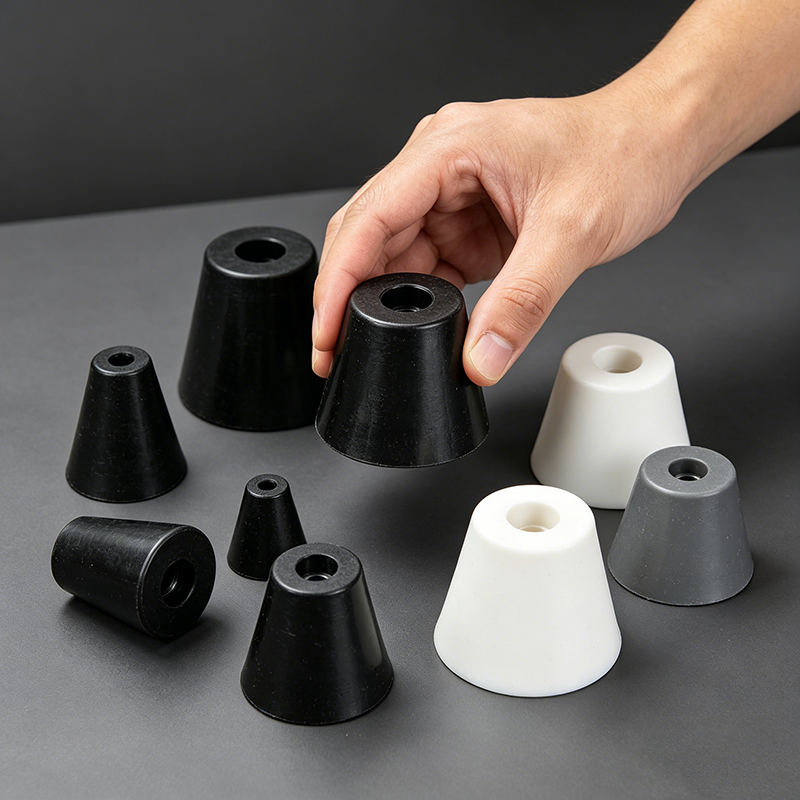
Start with these specific questions about your application:
Contact frequency and duration: Will users touch the component occasionally or handle it continuously? Brief incidental contact has different requirements than prolonged skin exposure.
Environmental conditions: What temperature, humidity, and chemical exposure will occur during use? Cleaning chemicals, oils, or solvents change material requirements significantly.
Mechanical loading: Does the component experience compression, friction, or abrasion during human contact? These forces affect both safety and performance.
User population: Will children, elderly users, or people with sensitive skin contact the component? Some applications require additional safety margins.
Regulatory requirements: Do industry standards, customer specifications, or regulatory bodies mandate specific material properties or testing?
Next, convert these conditions into testable requirements:
| Application Aspect | Testable Requirement |
|---|---|
| Skin contact safety | Cytotoxicity testing per ISO 10993 |
| Chemical migration | Extractables testing per relevant standards |
| Surface properties | Roughness, hardness, friction measurements |
| Cleaning compatibility | Chemical resistance after cleaning agent exposure |
| Temperature exposure | Property retention after thermal cycling |
Now evaluate both silicone and rubber candidates against these specific requirements. Don't eliminate options based on material family assumptions.
I recommend this evaluation sequence: First, identify qualified compounds from both material families. Second, compare their performance against your documented requirements. Third, consider manufacturing, cost, and supply chain factors. Fourth, validate the selected material through appropriate testing.
The goal is selecting the material that best satisfies all requirements, not the material with the better safety reputation.
Proper documentation transforms material safety from an assumption into a controlled engineering decision. This documentation protects your project from late-stage complications.
Create traceable records linking your human-contact requirements to specific material grades, test results, and supplier certifications. Generic material names aren't sufficient for safety-critical applications.


Essential documentation includes material datasheets with complete compound identification. Generic terms like "silicone" or "rubber" create ambiguity. Specify the exact polymer type, hardness, additives, and processing aids.
Safety testing results must match your application conditions. Cytotoxicity testing demonstrates biocompatibility. Extractables testing shows chemical migration levels. Skin sensitization testing identifies allergic reaction potential. These tests must use your actual production material, not similar compounds.
Supplier certifications verify material consistency. ISO 9001 quality systems ensure repeatable processes. Material traceability allows lot-specific tracking. Supplier audits confirm capability and compliance.
Manufacturing process documentation prevents safety variations. Molding parameters affect material properties. Curing conditions influence chemical stability. Post-processing treatments change surface characteristics. Document and control these variables.
Here's the minimum documentation package I recommend:
| Document Type | Required Content |
|---|---|
| Material specification | Exact compound, grade, hardness, color |
| Safety test reports | Biocompatibility results for production material |
| Supplier certifications | Quality system, material compliance, traceability |
| Process parameters | Molding, curing, post-processing conditions |
| Inspection criteria | Incoming material, finished part requirements |
| Change control | Procedures for material or process modifications |
Change control deserves special attention. Material suppliers sometimes modify formulations without notification. Process changes can affect material properties. Establish procedures requiring approval before any safety-related changes.
Regular audits maintain documentation accuracy. Review supplier certifications annually. Verify test report validity. Confirm process parameter compliance. Update specifications when requirements change.
Remember that documentation serves multiple purposes. It supports regulatory compliance, enables supplier qualification, facilitates problem solving, and provides legal protection. Invest in complete documentation from the beginning rather than scrambling to create it later.
Conclusion
Material safety depends on proper specification, testing, and validation rather than choosing between silicone and rubber based on reputation alone.