

Are you concerned about the safety of rubber products that come into contact with people? You're not alone in wondering whether rubber materials pose health risks.
Rubber isn't inherently "good" or "bad" for humans. The safety depends entirely on the specific rubber formulation, manufacturing process, and how people will actually use the product. The real risk comes from selecting materials without properly evaluating the human contact requirements.
After 27 years in rubber manufacturing, I've seen too many projects fail not because rubber is dangerous, but because teams never properly defined what "safe for human contact" means for their specific application. Let me share what I've learned about making informed decisions.
Does Rubber Type Really Matter for Human Safety?
Have you ever wondered why some rubber products feel perfectly safe while others cause concerns? The answer lies in understanding that "rubber" isn't a single material.
Different rubber compounds have vastly different safety profiles. Silicone rubber used in medical devices meets strict biocompatibility standards, while industrial rubber compounds may contain additives unsuitable for human contact. The polymer base, additives, and curing agents all influence safety.


I remember working with a client who assumed all black rubber was the same. They wanted to use an industrial gasket compound for a consumer product handle. The mechanical properties were perfect, but the formulation contained accelerators and antioxidants that weren't appropriate for repeated skin contact.
We manufacture products using various rubber families. Each serves different purposes. Natural rubber offers excellent elasticity but may cause latex allergies. EPDM provides weather resistance but requires careful additive selection for skin contact. NBR excels in oil resistance but some grades contain components better suited for industrial use. Silicone rubber offers the best biocompatibility but costs more and has different mechanical properties.
The key insight is this: mechanical suitability and human contact suitability are separate approval questions. A material can perform perfectly in compression tests while still requiring evaluation for skin contact applications. We always recommend defining the human contact requirements before selecting the base polymer. This prevents expensive material changes after tooling is complete.
| Rubber Type | Best Applications | Human Contact Considerations | Typical Concerns |
|---|---|---|---|
| Silicone | Medical devices, food contact | Excellent biocompatibility | Higher cost, limited hardness range |
| EPDM | Outdoor applications, seals | Good with proper formulation | Additive selection critical |
| NBR | Oil-resistant applications | Varies by grade | Some formulations contain problematic additives |
| Natural Rubber | General purpose, high elasticity | Latex allergy potential | Protein content, accelerator selection |
Can Manufacturing Processes Create Hidden Safety Risks?
Are you aware that how rubber is made can be just as important as what it's made from? Manufacturing processes can introduce or eliminate safety concerns that aren't obvious from the material specification alone.
Manufacturing processes significantly impact rubber safety through surface treatments, curing conditions, and residual chemicals. Post-curing, washing, and surface finishing can remove potentially harmful residues, while improper processing can leave unsafe compounds on the surface.


Last year, we helped a customer solve a mysterious skin irritation issue. The rubber formulation was perfectly safe, but their previous supplier used a mold release agent that left residues on the surface. The parts passed all dimensional checks but failed when people actually handled them.
Our manufacturing approach focuses on controlling every step that affects human contact. We use food-grade mold release agents for consumer products. Our post-curing process removes volatile compounds that might cause odors or irritation. We wash parts when required to remove surface residues. Quality control includes checking for proper cure, which ensures chemical stability.
Temperature control during curing is critical. Under-cured rubber can continue releasing chemicals long after manufacturing. Over-curing can create degradation products. We monitor cure state using rheometer testing and visual inspection. Proper curing creates stable, inert surfaces that won't continue changing after the product reaches users.
Compression molding, our primary process, offers better control over surface quality compared to some other methods. We can adjust pressure, temperature, and time to optimize both mechanical properties and surface characteristics. This control becomes essential when parts will contact skin repeatedly.
Surface finishing matters more than most people realize. Smooth surfaces are easier to clean and less likely to harbor contaminants. Textured surfaces might feel better but can trap cleaning agents or other chemicals. We work with customers to balance functional requirements with cleanability and safety considerations.
What About Chemical Additives in Rubber Products?
Do you know what's actually inside the rubber products you use every day? The additives used in rubber formulations can have more impact on human safety than the base rubber itself.
Rubber additives including accelerators, antioxidants, plasticizers, and fillers directly affect human safety. Some industrial-grade additives that improve mechanical properties can cause skin sensitization or other health concerns. Medical and food-grade formulations use safer alternatives.
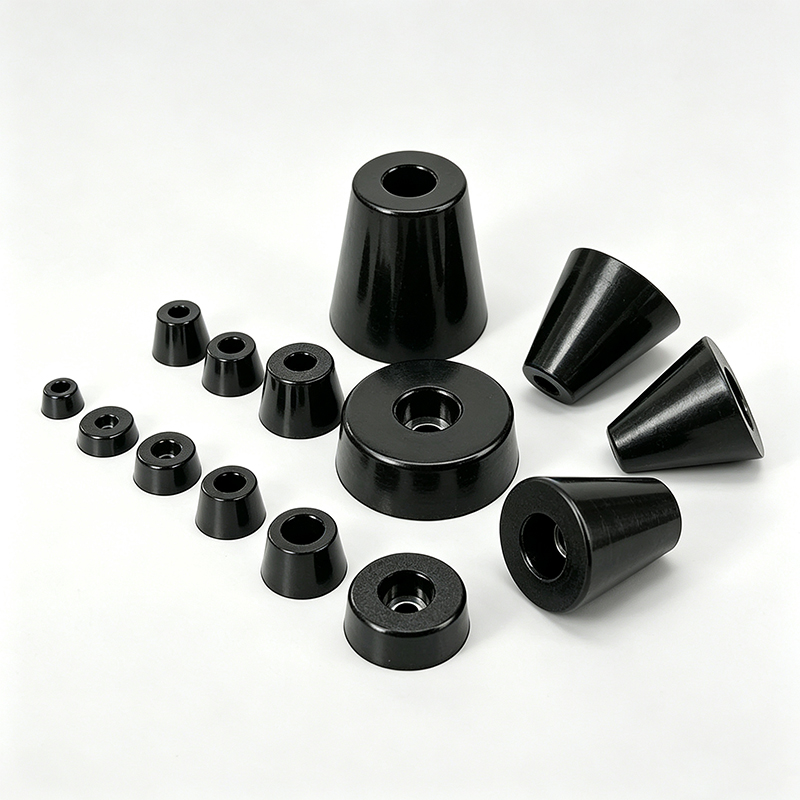
I've seen projects derailed because purchasing departments focused only on hardness and cost while ignoring additive packages. One electronics manufacturer had to recall products because their rubber feet contained a plasticizer that migrated to surfaces, creating a sticky residue that users found objectionable.
Understanding additive safety requires looking beyond the rubber polymer. Accelerators speed up curing but some types can cause allergic reactions. We use safer accelerator systems for human contact applications, even though they cost more. Antioxidants prevent aging but some can migrate to the surface over time. We select non-blooming antioxidants for products that people will touch.
Fillers affect more than just cost and hardness. Carbon black is safe and provides reinforcement, but some industrial fillers contain traces of heavy metals. We use only approved fillers for consumer products. Plasticizers make rubber softer but can migrate out over time. Phthalate-free plasticizers cost more but eliminate long-term safety concerns.
Color additives present their own challenges. Some pigments contain heavy metals that are fine for industrial use but inappropriate for consumer products. We maintain separate color systems for different application categories. UV stabilizers prevent degradation but must be chosen carefully for skin contact applications.
The solution isn't eliminating all additives – that's impossible. Modern rubber requires additives to function properly. The key is selecting appropriate additives for the intended use and ensuring they're properly incorporated during mixing. We maintain detailed formulation records so customers know exactly what's in their products.
How Do You Evaluate Rubber Safety for Your Application?
Are you struggling to determine whether a rubber material is appropriate for your specific application? The evaluation process requires more than just checking if something is labeled "safe."
Proper rubber safety evaluation requires defining the actual exposure conditions, understanding the material composition, testing under realistic conditions, and documenting compliance with relevant standards. Generic safety claims without application-specific validation provide false confidence.
Three months ago, a medical device company asked us to evaluate their existing rubber component. They'd been using it successfully for two years, but a regulatory audit questioned their safety documentation. We discovered they had excellent mechanical test data but no records showing the material was appropriate for their specific contact conditions.
Evaluation starts with defining exposure conditions precisely. Will the rubber contact bare skin or through clothing? How long will contact last? What temperature conditions? Will cleaning chemicals contact the surface? These details determine what safety requirements actually apply. Vague requirements like "biocompatible" or "safe" don't provide enough guidance for proper evaluation.
Material documentation comes next. We provide detailed formulation information including polymer type, additive systems, and processing conditions. Customers need this information to assess whether our standard compounds meet their requirements or whether custom formulations are necessary. Material safety data sheets provide basic safety information but don't address application-specific concerns.
Testing should match real-world conditions. Skin sensitization tests use different protocols than food contact evaluations. We work with certified laboratories to conduct appropriate testing when required. Standard mechanical tests don't predict human safety performance, so additional testing protocols may be necessary.
Regulatory compliance varies by industry and geography. Medical devices have different requirements than consumer products. European regulations differ from US standards. We help customers understand which standards apply to their products and provide documentation to support compliance efforts.
Documentation and traceability become critical for regulated products. We maintain batch records showing exactly which materials were used in each production run. This traceability helps customers respond to regulatory inquiries and supports quality investigations if issues arise later.
Conclusion
Rubber safety depends on choosing the right material for your specific application and validating it properly before production begins.