

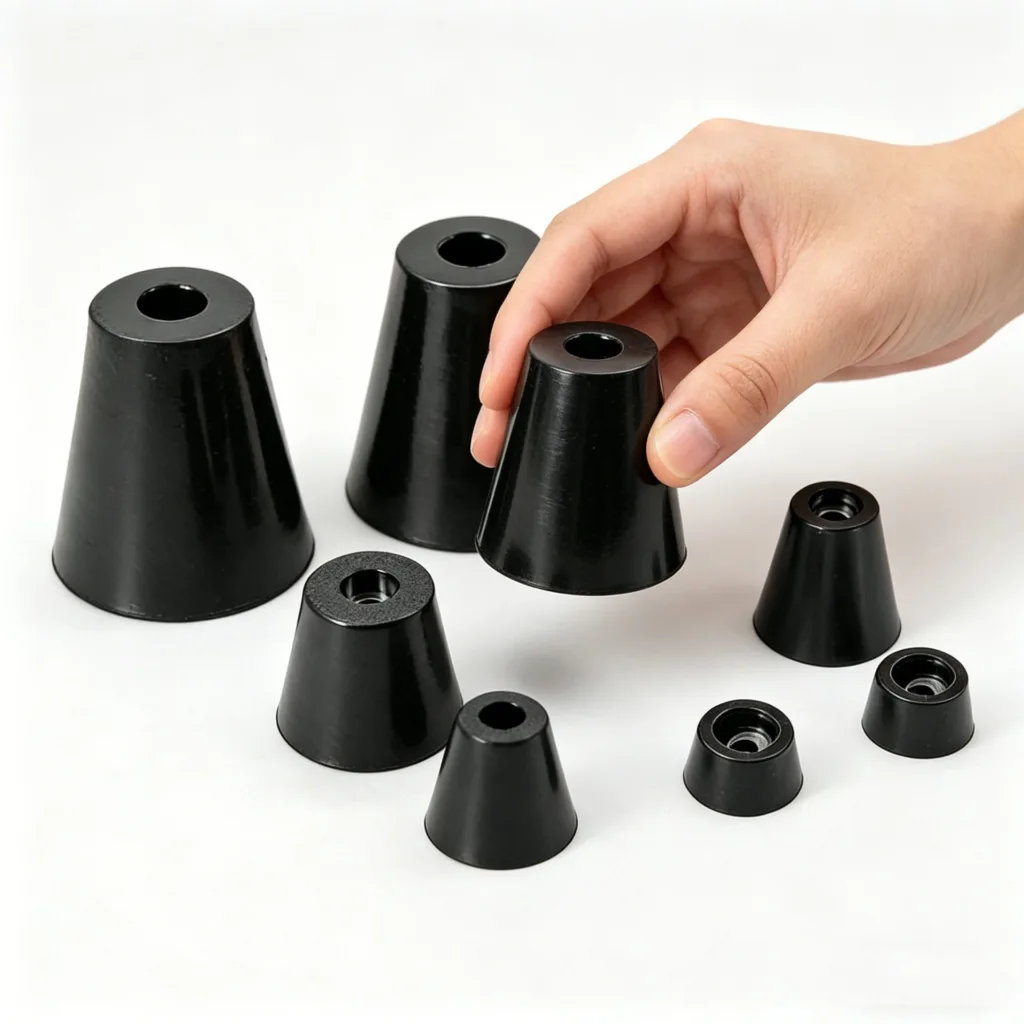
Air compressor projects often treat rubber feet as simple support components. Yet these small parts cause the biggest production failures. I've seen thousands of units recalled because teams ignored vibration engineering.
Air compressor isolator pads and rubber feet require vibration system design, not basic load-bearing selection. Most project failures occur because teams focus on hardness and price while ignoring dynamic stiffness, natural frequency, and compression set resistance.
The stakes are higher than most teams realize. When vibration control fails after mass production, the cost exceeds the part value by thousands of times.
What Makes Teams Treat Vibration Isolators as Simple Load-Bearing Parts?
Project teams face pressure to control costs and meet deadlines. Rubber feet seem like the easiest place to save money. I understand this thinking because I made the same mistakes early in my career.
Teams calculate static load capacity and assume success. A 35kg compressor needs 8.75kg per foot, so any 10kg-rated pad should work. This logic ignores vibration dynamics completely.


The real forces include motor vibration, crankshaft inertia, cylinder pulses, start-stop impacts, and resonance amplification. Static calculations miss these entirely.
I learned this lesson during a 60,000-unit project where we replaced NR isolator pads with cheaper alternatives. The lab tests showed identical dimensions, hardness, and load capacity. The price dropped 18%. Everyone celebrated the cost savings.
Three months after production started, customers reported increased noise. By 1,500 operating hours, we saw loose bolts and ground vibration. Equipment developed weld cracks and cover damage. European customers started returning units.
The investigation revealed dynamic stiffness deviation exceeding 40%. Our "identical" pads had completely different vibration isolation performance. The project required nine months to fix and cost over $1.8 million in field repairs.
The purchasing manager focused on cost reduction. The structural engineer only checked drawings. Quality control verified dimensions. Nobody validated dynamic vibration performance. We treated a vibration control system like a commodity rubber part.
How Do Specification Gaps Create Supplier Disputes?
Most air compressor isolator pad disputes stem from incomplete specifications. Teams write requirements that seem complete but miss critical performance parameters.
Material definitions often specify "rubber material" without controlling compound formulation. Suppliers might deliver NR, SBR, EPDM, or recycled blends with vastly different dynamic properties.


I've seen projects specify "60 Shore A" without tolerance bands. Suppliers deliver anything from 55A to 65A. This hardness variation changes natural frequency significantly. The compressor might work perfectly with 55A pads but resonate badly with 65A versions.
Dynamic stiffness represents the most serious specification gap. Many drawings completely omit this parameter. Suppliers control hardness but cannot guarantee vibration isolation performance. The team discovers problems only after thousands of units reach customers.
Compression rate definitions create another common problem. Specifications rarely define installation pre-compression amounts. Actual vibration isolation becomes unpredictable. Some installations provide excellent damping while others amplify vibration.
Working environment conditions get overlooked frequently. Oil contamination, high temperatures, and ozone exposure dramatically affect rubber aging rates. Pads that perform well initially might fail within months under harsh conditions.
Test condition definitions remain incomplete in most specifications. Requirements state "vibration test pass" without defining frequency ranges, excitation forces, or test durations. Results cannot be compared between suppliers or validated against actual service conditions.
Lifetime verification gets skipped entirely. Teams rarely require compression set resistance, dynamic fatigue testing, or aging performance data. Mass production units experience performance degradation that was never evaluated during development.
Why Do Successful Lab Tests Lead to Production Failures?
Laboratory success creates false confidence because test conditions don't match real service environments. I witnessed this pattern repeatedly across multiple air compressor projects.
New isolator pads provide excellent elasticity and vibration isolation during short-term lab tests. Extended operation causes compression permanent deformation, hardening, and reduced rebound capability that gradually degrades isolation performance.


The degradation follows a predictable timeline. Stage one shows normal operation with fresh pads providing adequate vibration isolation. Stage two reveals gradual rubber compression and stiffening as equipment height slowly changes. Stage three demonstrates reduced isolation efficiency as vibration transmits to the base structure.
Stage four creates the most dangerous condition. Natural frequency approaches equipment operating frequency. Vibration amplifies rather than isolates. The system experiences shell cracking, pipe fatigue, and joint failures that lead to customer complaints.
I managed a project where NVH analysis revealed our 65 Shore A pads created a 31Hz natural frequency. The compressor operated at 28Hz. This dangerous proximity would cause resonance problems within months of operation.
We modified the design to 50 Shore A material and increased pad height from 12mm to 18mm. The new specification included dynamic stiffness requirements and compression set limits. Additional validation included vibration sweep testing, resonance evaluation, and 1000-hour endurance runs.
The final product achieved 4.8dB noise reduction compared to the original design. We avoided resonance problems, customer complaints, and field retrofits. The project saved approximately eight months of remediation time by treating isolator pads as a vibration control system rather than simple support components.
Teams that skip dynamic validation discover problems after thousands of units reach customers. Fixing these issues requires complete redesign, supplier changes, and extensive field service campaigns that cost far more than proper initial engineering.
How Should Teams Structure Risk Control for Isolator Pad Projects?
Effective risk control requires systematic changes across multiple project functions. Each role needs specific responsibilities and clear validation requirements.
Technical leadership must establish vibration system design standards that define natural frequency targets, vibration transmissibility limits, and dynamic stiffness ranges before any supplier selection begins.
Purchasing responsibilities include requiring dynamic stiffness reports, compression set data, and aging performance information in all RFQ documents. Cost comparisons must include vibration performance metrics, not just hardness values and unit prices.
Quality control needs specialized validation protocols covering vibration testing, fatigue evaluation, and accelerated aging assessment. Standard dimensional inspection cannot verify vibration isolation capability.
Project management must include vibration validation in critical path scheduling. NVH evaluation cannot be skipped or delayed without compromising project success. Resonance problems discovered after tooling completion require expensive redesign cycles.
Supplier management requires strict change controls for any modifications affecting rubber compound formulation, filler ratios, curing processes, or mold structures. These changes can dramatically alter dynamic properties even when dimensional specifications remain unchanged.
Sample validation must measure actual vibration attenuation rates, natural frequency values, and installation compression amounts. Laboratory testing needs resonance evaluation, vibration sweep analysis, and fatigue assessment using production-grade compounds.
Design validation and production validation phases need different requirements. DV testing validates design concepts while PV testing confirms manufacturing consistency. Both phases must use actual production materials and processes.
Production monitoring should track batch-level dynamic stiffness, compression set resistance, and aging characteristics. Quality trends often indicate developing problems before customer complaints occur.
Acceptance criteria must simultaneously satisfy dimensional tolerances, dynamic stiffness ranges, compression set limits, and vibration transmissibility requirements. Missing any parameter creates risk exposure.
Early warning systems should trigger investigations when noise levels increase beyond 2dB, vibration values rise above 15%, pad height decreases more than 10%, or bolt loosening rates increase. These symptoms often indicate isolation system degradation before complete failure occurs.
Conclusion
Air compressor isolator pad failures occur when teams treat vibration control systems as commodity rubber parts, focusing on static loads while ignoring dynamic performance requirements.