

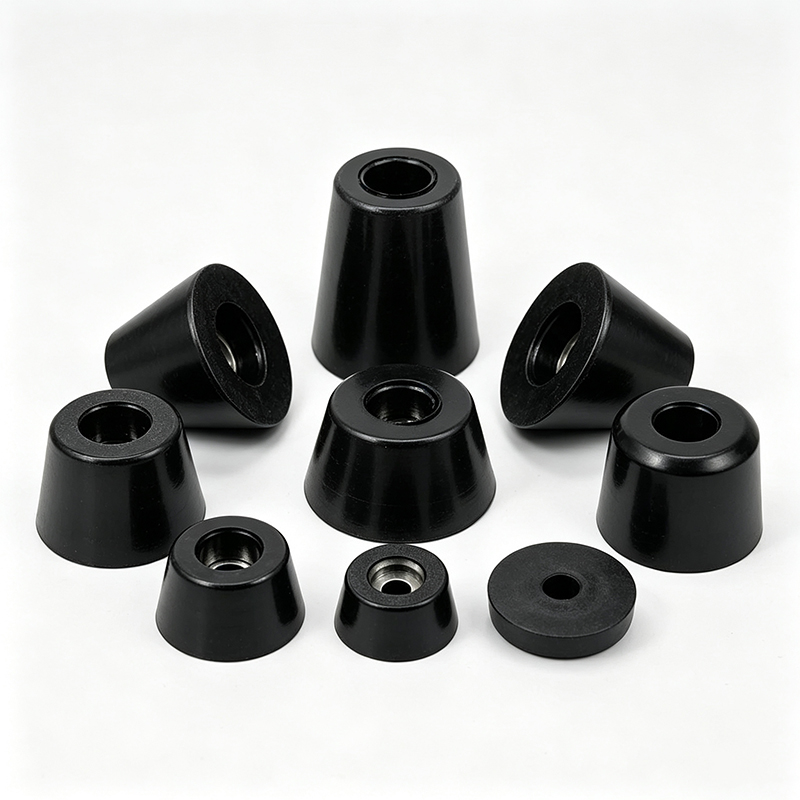
Buying rubber feet looks easy. But wrong choices cause terrible assembly failures later. I will show you exactly what to check to buy the right rubber components every time.
When buying rubber feet, you must check more than just price and size. You need to verify material selection, load capacity, anti-slip performance, and mounting fit. A perfect size does not guarantee good performance. You must test the parts under real working conditions before mass production.


Many buyers think a simple visual check is enough. They place large orders based on a quick look at a sample. This simple mistake ruins whole production lines.
What is the biggest purchasing risk for rubber feet?
You might pick a supplier because they offer a low price. Then the parts break under pressure. You must look beyond simple costs and basic shapes.
The biggest risk is choosing rubber feet based only on price, look, and basic dimensions. A rubber foot might fit perfectly during a sample check. But it can fail in actual use due to bad material, weak load capacity, or a bad mounting fit.


I have seen this happen many times in my 27 years in the rubber industry. A customer brings us a failed part from another factory. They ask me why it broke. I tell them that a perfect size does not guarantee good performance. We must look at the real working conditions.
Why do basic checks fail?
I always tell my clients that a rubber foot does much more than just cover a hole. It supports heavy weight. It stops sliding on wet floors. It absorbs machine vibration. If you only check the size, you miss the main functions. Let us break down the common failure reasons.
| Failure Reason | What Happens in Real Use |
|---|---|
| Incorrect material | The rubber cracks or melts under high heat. |
| Weak load capacity | The foot crushes flat under heavy equipment. |
| Bad anti-slip | The machine slides across the smooth floor. |
| Bad mounting fit | The foot falls out when you lift the machine. |
| High compression | The rubber loses its shape forever. |
| Inconsistent quality | One batch works fine, but the next batch fails completely. |
I always test these physical factors in our factory. We make sure the dimensions are accurate to +/- 0.05 mm. But we also test the physical limits. You must do the same. Never trust a part just because it looks right on a paper drawing. You need real proof.
Why do typical OEM projects fail with rubber feet?
Your assembly line is running fast. Suddenly, the rubber feet fall off the machines. You face huge delays and angry customers because the project failed.
OEM projects usually fail because the team approves a sample without testing it under real conditions. The original rules often miss sliding resistance, holding power, or actual weight loads. This causes parts to move too much or fall off after delivery.


Let me share a story from a past client. A large manufacturer bought rubber feet for heavy industrial equipment. They checked the visual sample. They measured the size. Everything looked good to them. They approved mass production quickly.
What are the hidden costs of quick approvals?
After the supplier delivered the parts, the factory assembled the heavy machines. When workers moved the machines, the rubber feet shifted. Many feet lost their grip and fell out. I helped them investigate this problem. We found that their original rules were too simple. They did not define the actual operating loads. They did not test the mounting retention.
This mistake caused massive trouble for everyone. The project faced huge extra costs.
| Problem Area | Business Impact |
|---|---|
| Additional testing | The team wastes engineering time and money. |
| Inventory inspection | Workers must check thousands of bad parts by hand. |
| Replacement costs | The company buys new parts to fix the broken ones. |
| Production delays | The assembly line stops completely. |
| Responsibility disputes | Buyers and suppliers argue over who pays the bill. |
I always remind my team that we must ask the right questions early. The root cause of this failure was very simple. The buyer approved the sample without verifying performance under real operating conditions. You must test the part on the actual machine. You must push it, pull it, and load it with real weight before you buy it.
How can you prevent these rubber feet problems?
You do not want your project to fail and cost money. You feel stressed about picking the right specs. I have a clear plan to help you avoid this.
You can prevent problems by defining strict requirements for materials, dimensions, loads, and mounting. You must specify the exact rubber compound for your application. You also need to test samples on real contact surfaces to verify anti-slip performance and installation fit.


I always use a strict checklist when we develop new rubber feet. You cannot treat all rubber materials as the same thing. You must choose your material based on your real application. EPDM, NBR, NR, and silicone have very different properties. You cannot swap them without testing them first.
What are the right actions for risk areas?
I break down the risk areas for my clients. This helps them understand what they need to do before they buy.
| Risk Area | Required Action to Prevent Failure |
|---|---|
| Material | Specify the exact rubber type and chemical compound. |
| Dimensions | Define critical dimensions and acceptable size tolerances. |
| Load | Verify actual load distribution and rubber deformation. |
| Anti-slip | Test the part on representative contact floor surfaces. |
| Mounting | Verify holding retention and installation fit. |
| Sampling | Ensure the test samples represent actual mass production conditions. |
| Quality | Establish clear and measurable acceptance criteria. |
I tell buyers to write all these details into the contract. If you need a part for a hot environment, you must ask for silicone. If you need oil resistance, you must ask for NBR. We offer all these materials at our factory with full compliance options. We also provide full testing data. You must demand this data from your supplier. This is the only way to stop problems before they start.
How do you control project-level risks?
Managing a whole team is hard. When one department makes a mistake, the whole product fails. You must align everyone to control the risks properly.
You control project risks by giving clear jobs to each team member. Engineers must define loads early. Buyers must compare suppliers using the same rules. Quality teams must verify performance. Suppliers must control their molding processes. Project managers must fix risks before mass production starts.


Buying rubber feet is a team effort. I have worked with hundreds of OEM teams globally. The successful teams always have clear roles. The failing teams always work alone in separate departments. I want to show you how a good team controls risk.
How do clear roles help the whole team?
Every person must do their specific job well. If the design engineer misses a detail, the purchasing manager will buy the wrong part. We see this happen very often. I always ask my clients to organize their teams like this.
| Team Member | Core Responsibility |
|---|---|
| Design Engineers | Define load, mounting, and operating rules before design freeze. |
| Purchasing Managers | Compare different suppliers against the exact same approved rules. |
| SQE and QC | Verify material, dimensions, functional performance, and production consistency. |
| Suppliers | Control molding processes and get approval for any changes. |
| Project Managers | Ensure all critical risks are resolved before mass-production release. |
I act as the supplier in this list. My job is to control our in-house mold room and the production lines. We use a strict ISO 9001 system to ensure quality. But I need the buyer's team to give me the right rules. When everyone works together, the project runs smoothly. We avoid rework. We avoid delays. We avoid unnecessary costs.
Conclusion
The real risk is approving parts without real testing. You must define requirements, verify samples, and test performance first. This stops bad parts and prevents expensive customer complaints.