

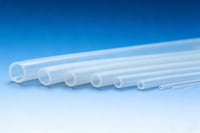
In my years working with rubber tubing, I've seen many projects that seem perfect on paper but fall apart when used in real life. Issues like leaks, wall collapses, and even sudden bursts can arise.
The most critical pitfall is this:
⚠️ The biggest pit: Choosing based on dimensions while neglecting the "Matching Working Pressure and Wall Thickness1."
Many people prioritize confirming:
- Inner Diameter (ID)
- Outer Diameter (OD)
- Length
But what truly determines stability is whether:
The pressure (Pressure) + wall thickness (Wall Thickness) are compatible.
🔍 Why is this issue so often overlooked?
Because under no pressure or low-pressure conditions:
The tubing appears to be normal. Installation goes smoothly.
However, once in actual working conditions, two typical problems can occur:
❌ Insufficient wall thickness2 → Tubing collapses or bulges.
- It may get crushed in a vacuum state.
- It can bulge in a positive pressure state.
- Flow can reduce or even stop.
❌ Exceeding pressure capacity3 → Direct bursting.
- It may not show immediate issues.
- Yet, under pressure fluctuations or temperature changes, sudden failure can happen.
👉 The root cause is: The size may be right, but the structural strength is inadequate.
📌 A real situation I faced
I worked on a project that used rubber tubing to deliver liquid.
The initial selection was standard:
- The inner diameter perfectly matched the interface.
- The outer diameter fit the installation space.
But after some time in operation, we experienced:
- Unstable flow rates.
- Local deformation of the tubing.
When we inspected on-site, we discovered:
👉 The tubing wall had collapsed under negative pressure.
The reason was simple:
👉 The wall thickness was too thin, unable to handle the actual working conditions.
We adjusted by:
- Increasing the wall thickness.
- Optimizing the material hardness.
Immediately, the issues disappeared, and the system stabilized.
✅ How to avoid this pitfall (very practical tips)
If you are selecting rubber tubing, focus on these three points:
1️⃣ First, confirm the "Actual Working Pressure4" (not just theoretical values).
Consider:
- Are there pressure fluctuations?
- Is there a vacuum state?
- Are there any sudden impacts?
👉 Many issues arise from "not considering dynamic pressure5."
2️⃣ Wall thickness design should leave safety margins.
Don’t just meet "barely enough." Instead, I recommend:
- Appropriately increasing the wall thickness based on pressure ratings.
- Or choosing a reinforced structure (like braided layers).
3️⃣ Material hardness6 must complement the structure.
If too soft:
- It can easily collapse.
If too hard:
- It can lack flexibility, making installation difficult.
👉 The key is compatibility, not just optimizing one aspect alone.
🧩 What should suppliers really do?
To be honest, merely producing rubber tubing based on dimensions is risky.
A more sensible approach is to:
- Confirm the actual working pressure and environmental conditions in advance.
- Help match suitable wall thickness and structure.
- Provide pressure suggestions or experiential references.
- Optimize material or structural designs when necessary.
Many problems are not created during use but are planted during the selection phase.
🤝 A final piece of advice
Rubber tubing may seem like a simple connector, but what truly determines its reliability is not the size but whether it can withstand real working conditions.
I have encountered too many cases where dimensions were perfect, yet failures occurred. So now, whenever I evaluate, I always ask:
“What pressure will this tubing work under?”
If we clarify this question from the start, most problems won't arise.
If you are selecting rubber tubing or unsure if your current design is under pressure risk, feel free to share your usage scenario. I can help you assess and avoid potential issues early on.
Understanding this concept is crucial for ensuring the reliability and safety of rubber tubing in various applications. ↩
Exploring this topic can help you avoid critical failures in your projects due to inadequate tubing strength. ↩
This resource will provide insights into the risks and preventive measures for tubing failures under pressure. ↩
Knowing how to assess working pressure is essential for selecting the right tubing for your needs. ↩
Understanding dynamic pressure can help you make informed decisions when selecting tubing for fluctuating conditions. ↩
This link will explain how material properties affect the performance and durability of rubber tubing. ↩