

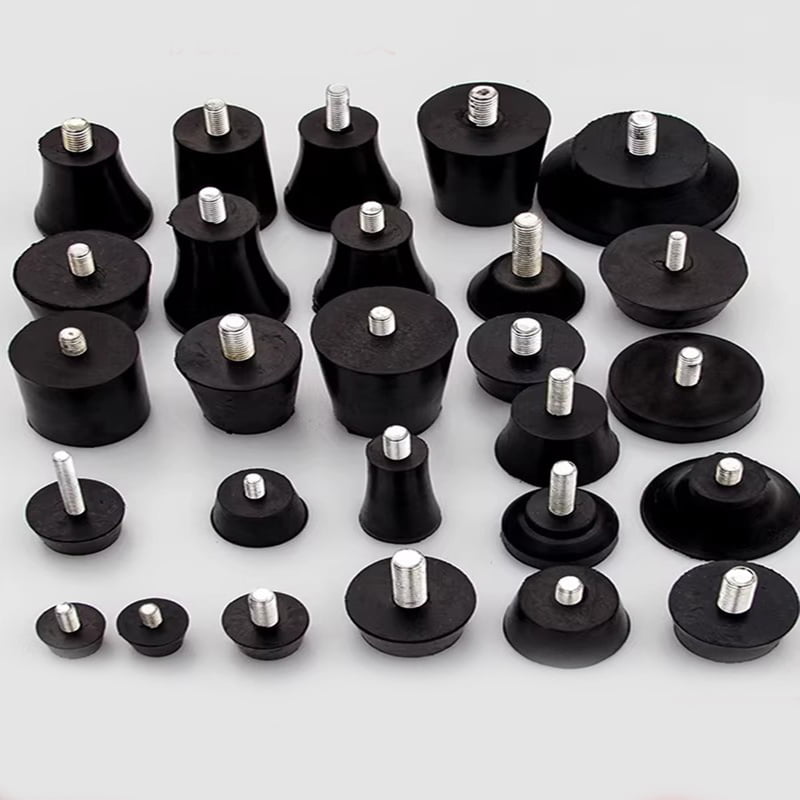
In the field of vibration damping, Anti Vibration Rubber Mounts1 are one of the most common and fundamental solutions. They are widely used in motors, compressors, generating equipment, and various industrial machines to reduce vibrations, minimize noise, and protect structures.
But in real projects, I often encounter a situation:
👉 Vibration mounts are installed, and the load is matched, yet the equipment still experiences noticeable vibrations or even resonance under certain conditions.
Many people's first reaction is that "the dampers are not good enough," but the actual issue often lies in a more critical but easily overlooked point.
The biggest pitfall: Ignoring "resonance frequency matching2" and only selecting based on weight.
When selecting Anti Vibration Rubber Mounts1, many people tend to choose based on equipment weight:
Total weight ÷ Number of support points → Single-point load Then select the corresponding load range for the vibration mounts ✔
This method is not wrong, but it only solves half of the problem.
What truly decides the damping effect is:
👉 Equipment excitation frequency vs. the inherent frequency of the damper3.
I once participated in a project:
A device with a motor that was reasonably configured in weight and distribution, and the vibration mounts were chosen based on load matching. However, during operation, noticeable vibration amplification occurred at a certain speed range.
Upon further analysis, it was found that:
👉 The operational frequency of the device was close to the inherent frequency of the vibration mounts, leading to resonance.
The result was not a failure of damping but rather the system entering a state of "amplified vibration."
How can we avoid this issue?
If you are in the selection process, I suggest not only focusing on "load matching," but also confirming one key dimension:
Does the operational frequency of the equipment pose a risk of resonance with the damping system?
Key points to focus on include:
- Equipment speed (RPM / Hz)
- Is there variable frequency operation (range of frequency variation)
- Are there shock loads or periodic vibrations
A practical tip:
👉 Try to keep the inherent frequency of the damper3s well below the equipment's excitation frequency (usually ≤ 1/3).
This can effectively avoid entering the resonance range, thus truly achieving vibration isolation rather than "transmitting or amplifying vibrations."
How did I help projects avoid this problem?
In actual projects, I do not recommend Anti Vibration Rubber Mounts1 solely based on weight. Instead, I first understand the complete working conditions:
- Range of operational frequencies
- Whether the load changes dynamically
- Installation method and support layout
- Any presence of multi-frequency vibrations4
Then we will:
- Backtrack the stiffness and structure of the dampers based on frequency, rather than the other way around.
- Match under multiple working conditions, rather than just targeting a single state.
- Adjust models or combinations as necessary to avoid falling into the resonance range.
Many projects achieved very stable results even with standard rubber vibration mounts after correctly matching frequencies.
Conclusion
Anti Vibration Rubber Mounts1 are not just a simple product where "matching the weight is enough." They are a systematic solution that requires a comprehensive assessment of frequency, structure, and working conditions.
If you overlook resonance, even with multiple vibration mounts installed, you may still not achieve the expected results.
If you are currently in the process of selecting vibration dampening solutions or have already encountered issues with increased vibrations at certain speed ranges, feel free to send me your equipment parameters or operating conditions.
I can help analyze whether there is a risk of resonance and provide a more reliable damping matching solution to ensure your equipment stabilizes under actual operation.
Explore the advantages of Anti Vibration Rubber Mounts to understand how they can effectively reduce vibrations and noise in various applications. ↩
Learn about resonance frequency matching techniques to ensure optimal performance and avoid vibration amplification in your projects. ↩
Understand the role of a damper's inherent frequency in achieving effective vibration isolation and preventing resonance. ↩
Find out how to effectively manage multi-frequency vibrations to enhance the stability and performance of your equipment. ↩